Finamac LLC
Industrial Açaí Production Line - Full Version
Industrial Açaí Production Line - Full Version
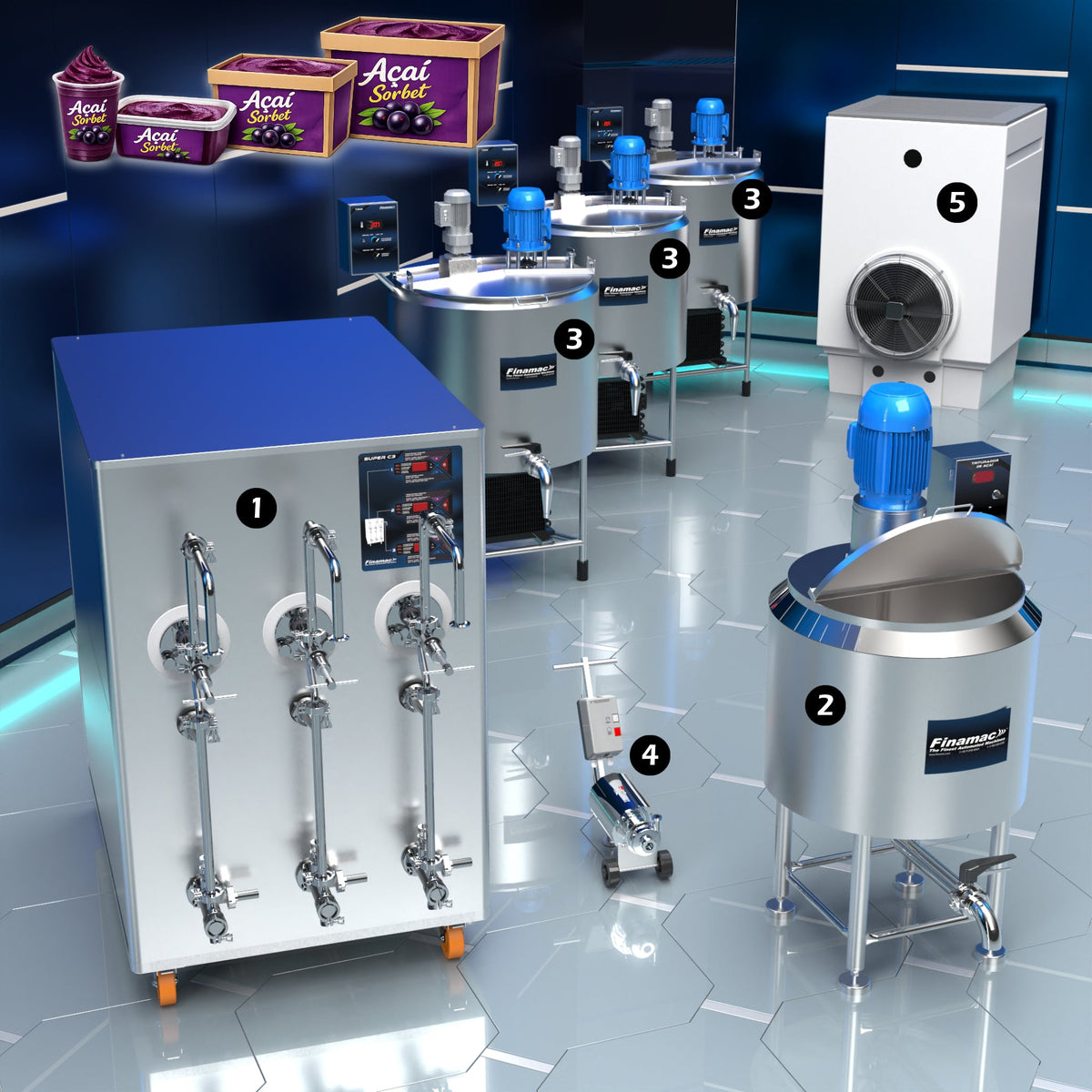
Illustrative Image *
Couldn't load pickup availability
🧊 INDUSTRIAL AÇAÍ PRODUCTION LINE- FULL VERSION
The most complete package in the industrial Açaí line, developed for companies that aim to operate with higher revenue potential and greater production versatility. The equipment includes 3 independent Açaí production units within a single cabinet, which can be used individually or in combinations of two or three units.
⚙️ Included equipment:
① Super C3
② Fruitmix600
③ 3 Tinas300
④ Transfer Pump Cart
⑤ Cooling Tower 20TR
See details about each machine in the “Machines” menu
Production capacity: up to 450 liters of açaí per hour.*
(*) With 10 to 30% aeration.
🍸 THE MOST COMPLETE BUSINESS MODEL FOR MAXIMUM RETURN POTENTIAL
The global Açaí ice cream market is estimated at USD 1.3 billion (2025), with most of it consumed in Brazil, as it is a major producer of this fruit in the Amazon, approximately 1.7 million tons in 2023. Producing Açaí ice cream has been a highly profitable business, especially due to its nutritional appeal, high energy density, antioxidant properties, cardiovascular health benefits, and, also very importantly, because it is consumed year-round, unlike the seasonality of conventional ice creams.
Simple to implement and with straightforward recipes, this equipment line is attractive for companies looking to expand an existing operation.
The business can be structured in different ways:
• as a manufacturing-only operation, supplying stores and distributors
• as a factory combined with a retail store
• or as a scalable multi-unit model, either through franchises or company-owned units
Talk to the Finamac team to learn about machine configurations and the different ways to compete in this market.
📊 ESTIMATED REVENUE POTENTIAL
Illustrative estimate of annual revenue (symbolic currency): 7.92 million coins.
Considering a production schedule of 5 hours per day, plus an additional 3 hours for preparation and logistics, this setup can produce approximately 2,250 liters of Açaí ice cream per day, or 45,000 liters per month based on 20 working days.
Considering that production remains constant throughout the year, with slight seasonal variation, and considering 11 months of operation and 1 month without production (cleaning, maintenance, and rest days), production can reach 495,000 liters per year or 3.96 million 125 ml scoops of Açaí ice cream.
For this example, a selling price of 2 symbolic coins per 125 ml scoop of Açaí ice cream is considered, which may vary depending on whether the product is sold wholesale or retail.
Based on this assumption, estimated annual revenue reaches 7.92 million symbolic coins.
On average, a scoop of ice cream can be sold to the consumer for up to 6 symbolic coins, which significantly increases profitability for those who produce and sell directly to the consumer.
The average production cost per 125 ml scoop of Açaí ice cream is around 0.80 symbolic coins, depending on the percentage of Açaí pulp in the recipe (30% to 70%) and the amount of air incorporated (10% to 30%).
Ice cream is typically packaged in disposable 5 or 10-liter containers for wholesale, in 100 to 500 ml containers for retail, and also in scoops for direct sales.
Naturally, other costs must also be considered, such as:
• labor
• rent
• equipment depreciation
• taxes
• commercial expenses
• logistics
• and other operating costs
Sales growth up to the level of 2,250 liters per day is gradual and depends largely on the business’s ability to promote itself and expand its market presence.
Profit margins can be quite attractive, but they depend on efficient management of all these variables, as well as many other strategic factors. In our Açaí production courses, we explore in depth the elements that drive long-term business success.
See courses and consulting in the “Training & Education” menu.
🏭 RECOMMENDED MACHINES
① SUPER C3
A continuous Açaí and ice cream production machine with compact dimensions, capable of reaching up to 120% air incorporation in the final product (30% for Açaí). It features automated start-up and full safety systems to prevent operational failures. It is highly practical, easy to move, and simple to operate.
② Frutmix600
Frozen Açaí pulp grinder. As it is a fruit that oxidizes easily, it must be processed and frozen quickly to preserve its nutritional characteristics. Frozen pulp cannot be heated for thawing, as oxidation increases with temperature.
For this reason, the grinder becomes essential to liquefy the pulp and allow the addition of other fruits, sugars, and other desirable ingredients.
The liquid mixture is then pumped into refrigerated tanks and from there is suctioned by the continuous ice cream machine to obtain the required temperature, creaminess, and aeration for the final product.
③ Tina 300 (3 units)
Refrigerated tank for storing liquid Açaí mixtures and other ingredients. Fully constructed in stainless steel, it ensures continuous supply to the production unit.
④ Transfer Pump Cart
Equipment used to transfer mixtures between the grinder and storage tanks. Practical and easy to use, it can be easily moved throughout the industrial facility.
⑤ Cooling Tower 20TR
Equipment required to cool the ice cream production machine. It must be installed outside the production environment.
🛠 MACHINE CERTIFICATIONS*
• CSA - Sanitary, upon request
• CE - European Community
* Certified models and conditions must be confirmed with our team.
🛠 MACHINE SUPPORT SERVICES
All machines may be serviced through various options, including:
• extended warranty programs
• preventive maintenance plans
• spare parts kits
• operation videos
• and additional technical information
Technical assistance may be provided online or on-site, depending on technician availability.
See the “Services and Maintenance” menu.
🏗 ACCESSORIES AND INFRASTRUCTURE
The machine set presented does not include essential factory infrastructure items, such as:
• freezers for product storage
• work tables
• handling utensils
• cabinets
• cleaning equipment
• delivery vehicles
• and other operational needs
Entrepreneurs should also plan the resources required for business administration and marketing, including:
• computers
• software
• internet and telephone services
• website development
• facility customization
• packaging customization
• promotional materials
• and related business tools
It is also extremely important to work with qualified professionals in areas such as accounting, architecture, and engineering to meet requirements for electrical, hydraulic, and civil installations, whether the operation is only a production unit or also includes a retail store open to the public.
This support is essential to ensure compliance with all applicable local regulations.
Finamac may provide, upon request, layout suggestions for machine positioning and the technical requirements necessary for proper operation. However, the final technical project must be developed by the entrepreneur through a qualified professional familiar with local legislation.
⚖️ LEGAL NOTICE
Production and Profitability Estimates
The production volumes, financial projections, profit estimates, and business examples presented on this site are provided for illustrative and informational purposes only.
These examples are based on theoretical scenarios, general industry assumptions, and operating conditions considered ideal, including, among other factors, production efficiency, labor availability, input costs, proper equipment operation, market demand, pricing strategies, and distribution capacity.
Actual results may vary significantly and depend on many factors beyond the company’s control, including, among others, operator experience, level of dedication to the business, local market conditions, operational practices, cost fluctuations, regulatory requirements, and other economic variables.
Nothing on this site should be interpreted as a guarantee, promise, or representation that any purchaser will achieve the same or similar levels of production, revenue, or profitability. The examples presented do not constitute a promise of performance or financial return.
By purchasing or using the equipment, the customer acknowledges that operating a food production or sales business involves inherent risks and that success depends on multiple factors, including management, marketing, operations, and strategic decisions made by the purchaser.
The company makes no guarantees regarding production capacity, sales performance, or business profitability. The purchaser is solely responsible for the operation of the business and for the results obtained.
Potential buyers are strongly advised to conduct their own financial analysis, market research, and business planning before purchasing any equipment or starting a production operation.
SKU:
Share