Finamac LLC
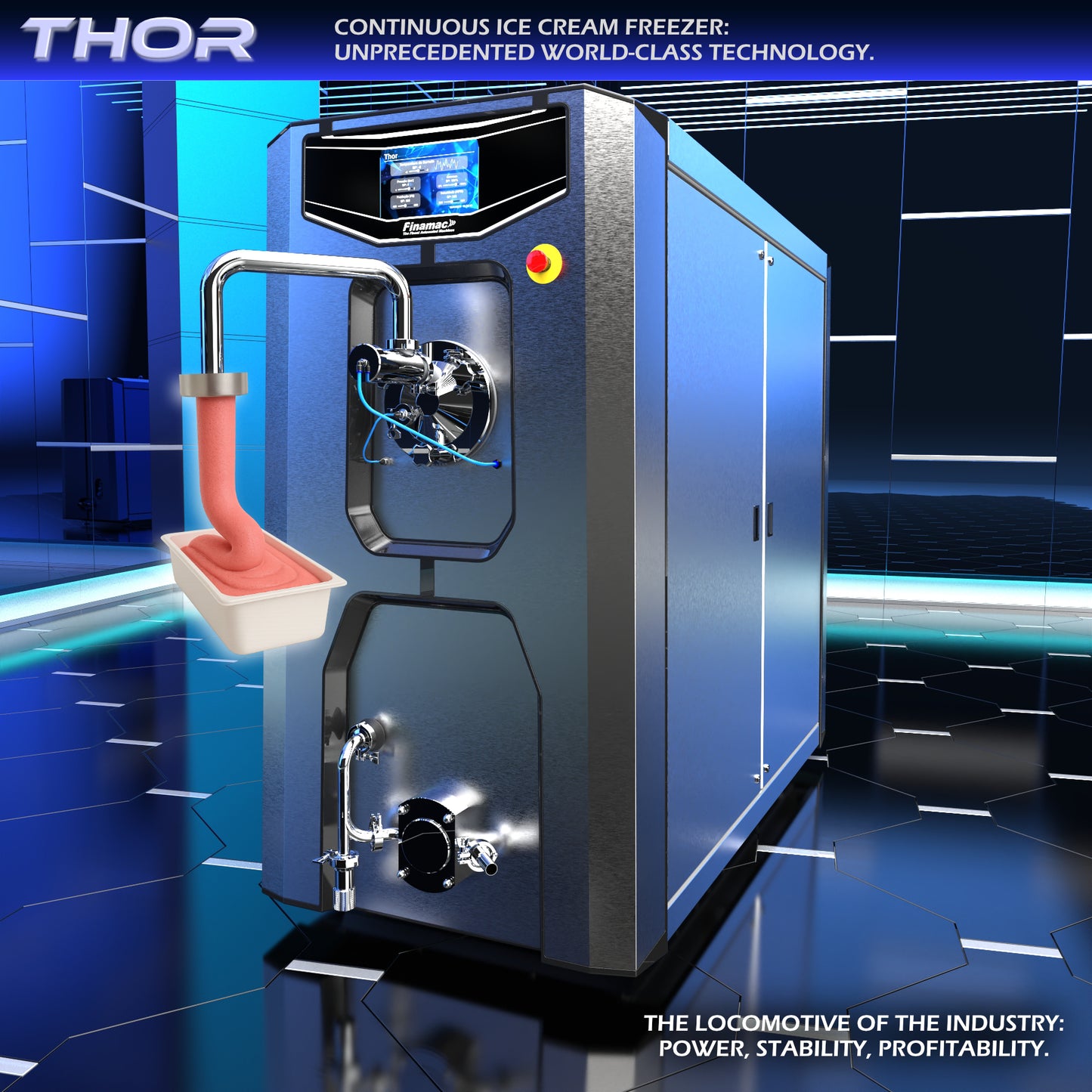
Thor - Industrial Ice Cream Producer
Thor - Industrial Ice Cream Producer
The most advanced generation of aerated ice cream producers.
The Ice Cream Market
Estimated at 57 billion dollars annually in 2017, this market is expected to reach 69 billion in 2022, representing a growth of 20% in 5 years.
This is a market divided between artisanal ice cream (made and sold on site), industrial ice cream (manufactured in factories and distributed to retail outlets), and soft ice cream (or soft serve, sold in fast food stores such as McDonald's). The share of each segment varies greatly from country to country; however, industrial ice cream holds the largest percentages as it is produced on a large scale by equipment such as the C-JET.
Industrial ice cream is produced by small, medium, and large companies, each with coverage areas proportional to their production capacity. Its main characteristics are high air incorporation (up to 120%) and long shelf life.
The Importance of Air Incorporation
Large-scale ice cream production requires a wide distribution network and, for this reason, the product must go through at least two levels of sales, starting with a distributor and subsequently several resellers beneath them. In addition, transportation and storage are also complex. All of this requires low production costs so that the final price is affordable to most consumers.
Air injection into ice cream can double its volume (100% more air) and often even exceed it (120%), substantially increasing the return margin so that it can be shared among distributors and resellers and cover transportation and storage infrastructure costs. The ice cream industry, however, still retains a good share of the profit, especially when analyzing the total revenue from large production volumes.
The air injected into ice cream therefore plays a fundamental role in its composition. To preserve its quality, all ice cream components must be balanced so that these large quantities of air are retained without nutritional, flavor, or creaminess losses.
Continuous Aerated Ice Cream Producers
Considered the locomotives of the ice cream industry, they are characterized by continuously whipping and freezing the product, drawing the mix (also called base mix) from a refrigerated tank on one side and, on the other side, dispensing the aerated ice cream through a simple tube or specifically shaped extruder.
The mix is whipped inside a cylinder with strong refrigeration around it, inside which a device containing blades rotates to scrape the ice cream that freezes on the cylinder walls. A pump injects more mix, together with air, into this cylinder as the already frozen ice cream is extracted.
Advantages:
Reduction in workforce involved in the ice cream manufacturing process. The equipment’s electronic control unit performs various monitoring and decision-making functions, requiring minimal operator intervention. Once the desired parameters for the ice cream are configured, the equipment manages all components to keep the production regime unchanged for many consecutive hours.
Lower energy cost per kilogram of ice cream produced due to the high thermal exchange between the refrigerant gas and the ice cream (thin, controlled cylinder wall), the efficiency of whipping and scraping inside the cylinder (fewer beater rotations to freeze and incorporate air), and the precise control of the refrigeration system (increasing or reducing cooling according to demand, without energy waste).
Guaranteed resale value as it is a compact, high-production piece of equipment equipped with cutting-edge built-in technology including all control systems. It is a high-efficiency, low-cost ice cream production module when compared to conventional industrial equipment.
Easy cleaning through the CIP (clean in place) washing system and fully removable parts for better sanitation at the end of production.
Target Audience
Medium and large ice cream industries with complete operational infrastructure.
Equipment with water-cooled condensation: requires a cooling tower.
SKU:
Share