Finamac LLC
Industrial Ice Cream Production Line – Basic Version
Industrial Ice Cream Production Line – Basic Version
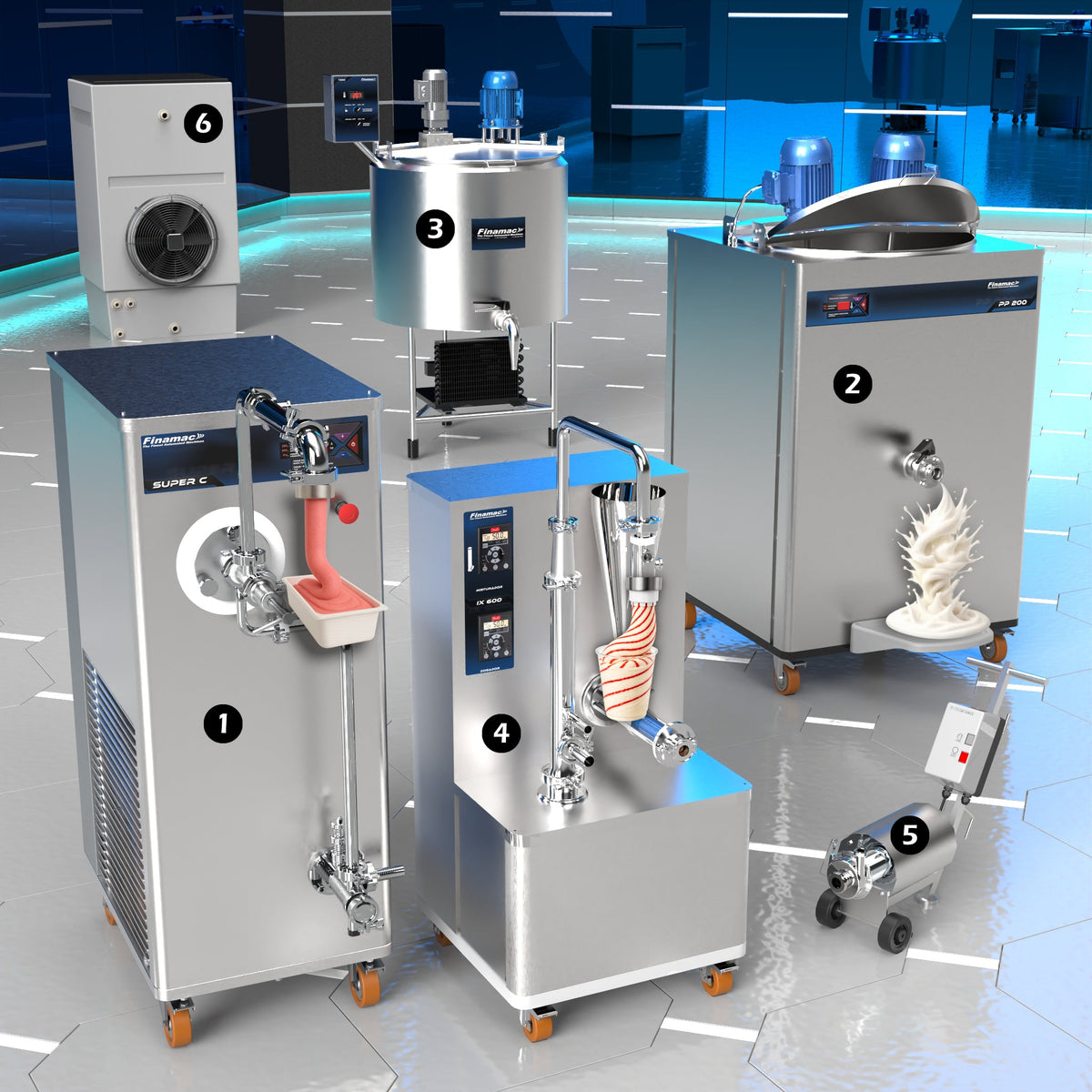
Illustrative Image *
Couldn't load pickup availability
🧊INDUSTRIAL ICE CREAM PRODUCTION LINE - BASIC VERSION
A practical, high-potential industrial production structure for companies that want to consolidate their presence in the water-based or milk-based ice cream market, with a versatile, efficient, and scalable solution.
This package is the most economical in the industrial line and represents an excellent foundation for new entrants into the industrial market.
⚙️ Included Equipment:
① SuperC
② PP200
③ Vat (Tina) 300
④ IX600
⑤ Transfer Pump Cart
⑥ Cooling Tower 10TR
See details about each piece of equipment in the “Machines” menu.
Production Capacity: Up to 200 liters of ice cream per hour.*
(*) With 100% air incorporation.
🍸 WHY THIS BUSINESS MODEL STANDS OUT
Known as aerated industrial ice cream or ice cream produced using continuous production machines, this product’s main advantage is the high percentage of air that can be incorporated, maximizing profit margins.
The global ice cream market is estimated at USD 125 billion, and approximately 60% of this value (USD 75 billion) is generated by the various types of ice cream currently produced. The projected market growth through 2033 is 36%, meaning the ice cream segment (excluding popsicles, which account for about 30% of the market) is expected to generate approximately USD 102 billion by that year.
In this context, ice cream manufacturing is and will continue to be a very strong and growing segment within the food and beverage industry.
Within the food sector, it is one of the product categories with the greatest ease of production and the lowest barriers to entry. From small to large-scale producers, it is one of the most balanced in terms of investment and offers one of the highest long-term returns on investment.
Talk to the Finamac team to learn about machine configurations and the different ways to compete in this market.
📊 ESTIMATED REVENUE POTENTIAL
Illustrative estimate of annual revenue (symbolic currency): 2.4 million coins.
Considering a production routine of 5 hours per day, plus 3 additional hours for preparation and logistics, this configuration can produce approximately:
• 1,000 liters of ice cream per day
• 20,000 liters per month (based on 20 working days)
Considering seasonality:
• 3 months per year at full production
• 9 months per year at half of that volume
In this scenario, production may reach approximately 150,000 liters of ice cream per year or 1.2 million scoops of 125 ml per year.
For this example, a selling price of 2 symbolic coins per 125 ml scoop is considered, which may vary depending on whether the product is sold wholesale or directly to the final consumer. Based on this assumption, estimated annual revenue reaches 2.4 million symbolic coins.
The average production cost per scoop may range from 0.20 to 0.80 symbolic coins, depending on the recipe, ingredients, and the amount of incorporated air (generally 100% or more).
Ice cream is typically packaged in disposable containers of 5 or 10 liters.
Naturally, additional costs must also be considered, such as:
• labor
• rent
• equipment depreciation
• taxes
• sales expenses
• logistics
• and other operating costs
Sales growth up to the level of 1,000 liters per day is gradual and depends largely on the business’s ability to promote itself and expand its market presence.
Profit margins can be highly attractive, especially with 100% air incorporation, and depend on efficient management of all these variables, as well as many other strategic factors.
For companies seeking a more detailed understanding of operational and commercial success factors, Finamac also offers specialized training and consulting.
See courses and consulting in the “Training & Education” menu.
🏭 RECOMMENDED MACHINES
① SUPER C
A continuous ice cream production machine with very compact dimensions, capable of reaching up to 120% air incorporation in the final product.
It features automated startup and all safety systems to prevent operational failures. It is highly practical, easy to move, and simple to operate.
② PP200
A heat treatment machine for milk-based mixtures, designed to reduce harmful microorganisms that could compromise product safety.
It results in much creamier, smoother, and more stable ice cream due to its aeration and homogenization system.
Its hot process improves the absorption and mixing of important ingredients, optimizing formulations and reducing ingredient consumption.
③ Vat (Tina) 300
Refrigerated tank for preparation, maturation, and storage of ice cream mixes.
Fully constructed in stainless steel, it ensures continuous supply to the continuous production machine.
④ IX600
Equipment used to insert colored syrups into the ice cream as it is discharged from the continuous freezer ① SUPER C.
Allows one syrup color.
⑤ Transfer Pump Cart
Equipment used to transfer mixtures between heat treatment and maturation tanks.
Practical and easy to use, it can be easily moved within the industrial plant.
⑥ Tower 10TR
Equipment required to cool the ice cream production machine and other water-cooled equipment.
Must be installed outside the production area.
🛠 MACHINE CERTIFICATIONS*
• CSA - Sanitary, upon request
• CE - European Community
* Certified models and conditions must be confirmed with our team.
🛠 MACHINE SUPPORT SERVICES
All machines can be supported through various service options, including:
• extended warranty programs
• preventive maintenance plans
• spare parts kits
• operation videos
• and additional technical information
Technical assistance may be provided online or on-site, depending on technician availability.
See the “Services and Maintenance” menu.
🏗 ACCESSORIES AND INFRASTRUCTURE
The set of machines presented does not include essential factory infrastructure items, such as:
• freezers for product storage
• work tables
• handling utensils
• cabinets
• cleaning equipment
• delivery vehicles
• and other operational needs
Entrepreneurs must also plan the resources required for administration and marketing, including:
• computers
• software
• internet and telephone services
• website development
• facility customization
• packaging customization
• promotional materials
• and related business tools
It is also extremely important to work with qualified professionals in areas such as accounting, architecture, and engineering to meet requirements for electrical, plumbing, and civil installations, whether the operation is only a production unit or includes a retail store open to the public.
This support is essential to ensure compliance with all local regulations applicable to the business location.
Finamac may provide layout suggestions and technical requirements upon request. However, the final project must be developed by a qualified professional familiar with local legislation.
⚖️ LEGAL NOTICE
Production and Profitability Estimates
The production volumes, financial projections, profit estimates, and business examples presented on this site are provided solely for illustrative and informational purposes.
These examples are based on theoretical scenarios, general industry assumptions, and operating conditions considered ideal, including, among others, production efficiency, labor availability, input costs, proper equipment operation, market demand, pricing strategies, and distribution capacity.
Actual results may vary significantly and depend on many factors outside the company’s control, including, among others, operator experience, level of dedication, local market conditions, operational practices, cost fluctuations, regulatory requirements, and other economic variables.
Nothing on this site should be interpreted as a guarantee, promise, or statement that any buyer will achieve the same or similar levels of production, revenue, or profitability. The examples presented do not constitute a promise of performance or financial return.
By purchasing or using the equipment, the customer acknowledges that operating a food production or sales business involves inherent risks and that business success depends on multiple factors, including management, marketing, operations, and strategic decisions made by the buyer.
The company does not provide guarantees regarding production capacity, sales performance, or business profitability. The buyer is solely responsible for operating the business and for the results obtained.
Potential buyers are strongly advised to conduct their own financial analysis, market research, and business planning before purchasing any equipment or starting a production operation.
SKU:
Share